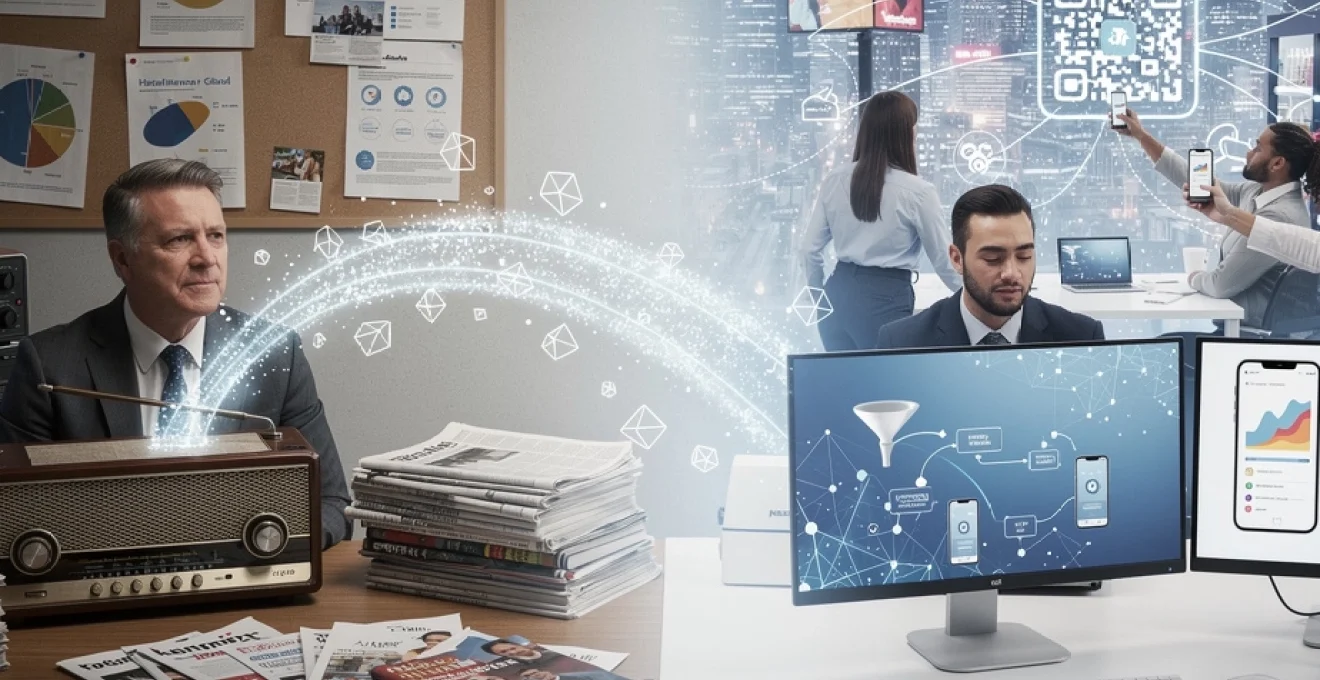
Marketing has undergone one of the most dramatic transformations in business history, evolving from broad, one-size-fits-all campaigns to highly personalised, data-driven strategies that speak directly to individual consumers. This evolution wasn’t a sudden disruption but rather a natural progression driven by technological advancement, changing consumer behaviours, and the need for more measurable, cost-effective marketing solutions. Traditional marketing laid the foundational principles of brand building, customer acquisition, and message amplification that digital marketing has enhanced and refined. What we’re witnessing today isn’t the replacement of traditional marketing but its sophisticated evolution into a more intelligent, responsive, and effective discipline.
Historical marketing paradigm shifts: from mass media broadcasting to personalised digital engagement
The transformation from traditional mass media marketing to personalised digital engagement represents one of the most significant paradigm shifts in commercial history. Traditional marketing operated on the principle of broadcast communication, where companies transmitted uniform messages to vast audiences through limited channels. This approach, while effective for its time, treated consumers as homogeneous groups rather than individuals with unique preferences and behaviours.
Television and radio advertising saturation points in the 1980s-1990s
By the 1980s and 1990s, television and radio advertising had reached critical saturation points that fundamentally challenged the effectiveness of traditional broadcast marketing. The average consumer was exposed to over 3,000 advertising messages daily, leading to what researchers termed “advertising fatigue” and declining response rates. Television commercial breaks extended to accommodate more advertisers, resulting in audience fragmentation as viewers increasingly switched channels or left the room during advertisements.
This saturation created a perfect storm for marketing innovation. Advertisers found themselves paying premium rates for diminishing returns, whilst consumers developed sophisticated filtering mechanisms to avoid unwanted marketing messages. The emergence of cable television further fragmented audiences, making mass reach campaigns less cost-effective and forcing marketers to reconsider their fundamental approaches to audience engagement.
Consumer behaviour evolution: from passive reception to active information seeking
Perhaps the most crucial factor driving marketing’s digital evolution was the fundamental shift in consumer behaviour from passive message reception to active information seeking. Traditional marketing assumed consumers would accept whatever information brands chose to share, when and how brands decided to share it. However, the internet empowered consumers to research products independently, compare options, read peer reviews, and make informed decisions on their own terms.
This behavioural transformation meant that successful marketing required a presence where consumers were actively looking for information rather than interrupting their activities with unsolicited messages. Search engines became the new battleground for customer attention, and brands that understood this shift gained significant competitive advantages over those clinging to traditional broadcast models.
Print media decline and the rise of search engine marketing
The decline of print media circulation paralleled the rise of search engine marketing, creating a clear illustration of marketing’s natural evolution. Newspaper readership declined by over 50% between 2000 and 2015, whilst Google processed over 3.5 billion searches daily by 2020. This wasn’t merely a technology substitution but a fundamental change in how consumers accessed and consumed information.
Search engine marketing emerged as the digital equivalent of print advertising but with unprecedented targeting capabilities and measurable results. Unlike print advertisements that appeared regardless of reader interest, search marketing connected businesses with consumers actively seeking their products or services. This intent-based marketing proved far more effective than traditional print advertising, offering higher conversion rates and better return on investment.
Direct mail response rates versus email marketing conversion metrics
The comparison between direct mail response rates and email marketing conversion metrics provides compelling evidence of digital marketing’s natural superiority. Traditional direct mail campaigns typically achieved response rates between 1-3%, considered successful in the industry. Email marketing, however, consistently delivers open rates of 20-25% and click-through rates of 2-5%, with the ability to track engagement in real-time and optimise campaigns immediately.
More importantly, email marketing costs approximately 95% less than direct mail whilst providing detailed analytics on recipient behaviour. This dramatic improvement in both effectiveness and efficiency demonstrates why digital channels naturally absorbed traditional marketing functions rather than simply competing with them.
Technology infrastructure convergence: how digital channels absorbed traditional marketing functions
CRM integration with multi-channel attribution models
As marketing shifted from isolated traditional campaigns to always-on digital ecosystems, customer relationship management (CRM) systems became the connective tissue between channels. In the broadcast era, it was difficult to link a TV spot, a print ad, and an in-store interaction to the same individual. Today, modern CRMs centralise customer data from email, social media, websites, call centres, and physical stores, enabling marketers to understand how each touchpoint contributes to acquisition and retention.
This convergence paved the way for sophisticated multi-channel attribution models that move far beyond the simplistic “last click” mindset. Instead of crediting only the final interaction before a conversion, marketers can now assign value across the full journey, from the initial display impression to the organic search visit and subsequent email click. In practice, this means that what used to be disconnected traditional marketing functions – brand awareness, consideration, and direct response – are now measurable parts of a single, trackable funnel anchored in the CRM.
For businesses, this integration turns marketing from a cost centre into a measurable revenue engine. When you can see that a prospect first heard about you via a podcast ad, clicked a retargeting ad a week later, and finally converted from an email offer, you can allocate budgets with surgical precision. The same core objective that traditional marketers always had – understanding what works – is now achievable at a granular level because digital channels feed rich behavioural data back into CRM platforms.
Programmatic advertising evolution from traditional media buying
Traditional media buying was largely driven by relationships, manual negotiations, and broad audience estimates. A brand might purchase a 30-second TV spot during a popular programme or a full-page magazine spread based on audience ratings and circulation numbers. Programmatic advertising took this same idea – placing messages in front of relevant audiences at scale – and translated it into automated, real-time bidding across digital inventory.
At its core, programmatic advertising is the algorithmic evolution of traditional media buying. Instead of booking ad space months in advance, software platforms now bid on individual impressions in milliseconds, using data signals such as behaviour, interests, and intent. The buyer still pursues reach and frequency, but now with the ability to exclude unlikely buyers, cap exposure, and optimise toward specific outcomes like conversions or cost-per-acquisition.
This shift doesn’t invalidate the principles of traditional media; it refines them. A brand that once bought national TV spots to reach “adults 25–54” can now reach “parents interested in eco-friendly products who abandoned a cart in the last 7 days” across streaming TV, display, and social. The underlying logic of reaching the right audience with the right message remains intact, but digital technology has dramatically increased the precision, efficiency, and accountability of each advertising pound spent.
Marketing automation platforms replacing manual campaign management
In the traditional era, campaign execution was labour-intensive and linear. Teams manually scheduled print insertions, booked TV spots, and sent one-off direct mail campaigns. Follow-up depended on sales teams and batch processes rather than real-time customer behaviour. Marketing automation platforms are the digital evolution of these workflows, enabling always-on, behaviour-based communication at scale.
Platforms such as HubSpot, Salesforce Marketing Cloud, and Mailchimp allow marketers to design multi-step journeys that respond automatically when a customer downloads a guide, visits a pricing page, or abandons a basket. What used to be a static three-month campaign plan becomes a living system that adapts to each individual. The principles of frequency, sequencing, and message mix still apply, but they’re now executed by rules, triggers, and workflows rather than spreadsheets and manual reminders.
This automation doesn’t remove the need for strategic thinking; it elevates it. Instead of spending time on repetitive tasks, you can focus on crafting better offers, testing new audiences, and refining your value proposition. In other words, digital marketing has taken the core strengths of traditional campaign planning – clear messaging, structured timelines, and defined objectives – and automated the execution layer so that every interaction can be timely, relevant, and measurable.
Social media analytics superseding traditional market research methodologies
Traditional market research relied heavily on surveys, focus groups, and periodic brand tracking studies. While valuable, these methods were expensive, slow, and often limited by small sample sizes and recall bias. Social media analytics emerged as a real-time, large-scale evolution of the same intent: understanding what customers think, feel, and say about brands and categories.
Social listening tools now analyse millions of public conversations across platforms like X, Instagram, TikTok, and forums to surface sentiment, emerging topics, and unmet needs. Instead of waiting weeks for a research report, marketers can see in hours how a new product launch, ad campaign, or PR issue is landing with their audience. It’s the digital equivalent of standing in every town square at once and hearing what people are actually saying.
This doesn’t mean traditional research is obsolete, but rather that it has been augmented and, in many cases, accelerated by digital data. When you combine structured surveys with unprompted social chatter, website behaviour, and customer feedback logs, you gain a far richer picture than any single traditional method could provide. In this way, social media analytics have naturally taken over many diagnostic and exploratory functions that once belonged solely to market research departments.
Data-driven marketing intelligence: the analytical revolution beyond traditional demographics
Traditional marketing segmentation was largely built on basic demographics: age, gender, income, and geography. While these variables are still useful, they offer only a surface-level understanding of your customers. Digital marketing has ushered in a data-driven revolution where behaviour, intent, and context matter just as much as who someone is on paper. Instead of guessing which magazine your target audience might read, you can now see exactly which pages they visited on your site, how long they stayed, and what content they engaged with.
Modern analytics platforms collect and unify data from multiple sources – websites, mobile apps, email, CRM, ad platforms, and offline systems – to create rich customer profiles. These profiles power advanced segmentation based on purchase history, browsing behaviour, engagement scores, and even predictive metrics like likelihood to churn or upgrade. It’s the difference between marketing to “women aged 35–44” and marketing to “loyal customers who have purchased three times in the last six months and regularly interact with our educational content.”
This depth of insight allows you to move from intuition-driven decisions to evidence-based strategies. Want to know which channels truly influence high-value customers or which content types shorten the sales cycle? With proper tagging, dashboards, and attribution models, you can quantify these answers rather than relying on educated guesses. The analytical revolution doesn’t discard the instincts that seasoned marketers developed in the traditional era; it validates, refines, or challenges those instincts with hard data.
However, this abundance of data also brings new responsibilities. Privacy regulations like GDPR and CCPA mean that we must handle customer information transparently and ethically, securing consent and respecting preferences. The most successful digital marketers are those who can balance the power of granular data with a strong commitment to trust, relevance, and value for the consumer.
Cost-per-acquisition optimisation: digital ROI measurement versus traditional marketing spend
One of the biggest frustrations with traditional marketing was the difficulty of accurately measuring return on investment. You could run a TV campaign and see a lift in sales, but connecting specific revenue to specific ads was often more art than science. Digital marketing, by contrast, was built from the ground up with measurement in mind. Clicks, impressions, conversions, and revenue can be tracked at the campaign, ad, keyword, and even individual user level.
Cost-per-acquisition (CPA) has become a central metric in this environment, allowing you to calculate exactly how much you spend to acquire each new customer across channels. If one campaign brings in customers at £20 each and another at £120, you have clear guidance on where to invest and where to cut back. This level of precision simply wasn’t available in the same way when most media buys were offline and attribution was largely inferential.
Digital channels also support continuous optimisation in a way traditional campaigns could not. Instead of locking in a three-month media buy and hoping for the best, you can run A/B tests, adjust bids, refine audiences, and tweak creative on a daily or even hourly basis. It’s like moving from steering a ship with a fixed rudder to having responsive controls that react instantly to every change in wind and current.
For smaller businesses in particular, this has been transformative. Where traditional advertising often required large upfront investments and long commitments, platforms such as Google Ads and Meta Ads allow you to start with modest budgets and scale only when you see positive results. The underlying objective – maximising ROI – is the same as it always was, but digital marketing has made achieving and proving that ROI far more accessible and transparent.
Omnichannel customer journey mapping: integration of digital and physical touchpoints
Despite the rise of digital channels, customers don’t live exclusively online or offline – they move fluidly between both worlds. Traditional marketing treated channels as largely separate silos: print, TV, in-store, and so on. Digital marketing represents the natural evolution towards omnichannel thinking, where every touchpoint is part of a single, connected customer journey.
Customer journey mapping is the practice of visualising and analysing all the interactions a person has with your brand, from initial awareness through consideration, purchase, and loyalty. In the past, this map might have been conceptual at best; today, it can be grounded in real behavioural data. When someone sees a billboard, searches your brand on their phone, visits your website on a laptop, and then buys in-store, you can now stitch these interactions together to understand patterns and friction points.
This integrated view allows you to design experiences that feel seamless rather than disjointed. For example, you might use digital ads to drive store visits, equip in-store staff with customer data from your CRM, and then follow up with personalised email offers after the visit. The basic logic of traditional path-to-purchase models still applies, but digital tools make it possible to actually measure, test, and refine each stage in real time.
Cross-device tracking and attribution modelling techniques
In a world where the average consumer owns multiple connected devices, understanding cross-device behaviour is critical. Traditional marketing couldn’t easily tell whether the person who saw a TV ad was the same person who later visited a store. Digital cross-device tracking takes that long-standing attribution challenge and addresses it using login data, device graphs, and probabilistic matching.
When a user logs into your app on their phone and your website on their laptop, you can unify those sessions into a single profile. Even when explicit logins aren’t present, sophisticated models can infer that two devices likely belong to the same person based on IP addresses, behaviour patterns, and other signals. This allows you to see that the ad clicked on mobile contributed to the purchase completed on desktop, rather than misattributing everything to the last device used.
From an attribution standpoint, this is a game-changer. Instead of underestimating the impact of upper-funnel mobile or social interactions, you can give them appropriate credit in your models. In practice, this means less wasted spend on channels that appear unprofitable at first glance and more investment in the full mix of touchpoints that actually drive conversions. The age-old desire to understand which half of the marketing budget is wasted is finally being addressed through these digital techniques.
Retail media networks and in-store digital integration
Retailers have long monetised shelf space, end caps, and in-store signage as advertising real estate for brands. Retail media networks are the digital evolution of this concept, turning retailers’ websites, apps, and even in-store screens into targeted, measurable ad platforms. Supermarkets, marketplaces, and big-box retailers now offer brands the ability to run sponsored product listings, onsite display ads, and personalised promotions based on shopping behaviour.
In-store, digital displays and interactive kiosks extend these capabilities into the physical environment. A shopper might see a personalised offer on their phone, receive a push notification when they enter a store, and then notice coordinated messaging on digital signage in the relevant aisle. What used to be static cardboard standees can now be dynamic screens updated in real time based on inventory levels, time of day, or campaign performance.
For brands, this convergence brings together the strengths of traditional trade marketing with the accountability of digital advertising. You’re no longer guessing how many people saw your in-store display; you can link impressions and engagements to actual sales through loyalty card data and point-of-sale systems. It’s a clear example of how digital marketing doesn’t replace traditional retail tactics but rather enhances them with data, personalisation, and agility.
QR code technology bridging offline-to-online consumer pathways
QR codes are a simple but powerful symbol of how offline and online marketing have fused. Initially introduced in the 1990s and widely adopted during the COVID-19 pandemic, QR codes function as a bridge between physical touchpoints and digital experiences. A print ad, poster, packaging label, or TV screen can now contain an instant gateway to a website, app, landing page, or loyalty programme.
In the traditional era, a call-to-action might have been a phone number or a generic URL that customers had to remember and type manually. With QR codes, the path is reduced to a single scan, dramatically lowering friction. This allows you to track exactly how many people engaged with an offline asset, which offers they responded to, and what actions they took afterwards – analytics that were nearly impossible with purely analogue tools.
From restaurant menus and event tickets to out-of-home advertising and product packaging, QR codes transform static media into interactive entry points. They demonstrate, in a very tangible way, how digital marketing is the natural continuation of traditional practices: the poster is still there, the leaflet still exists, but now they’re connected to a rich digital ecosystem of content, data, and ongoing engagement.
Artificial intelligence and machine learning: the next evolutionary phase in marketing automation
If digital marketing was the natural evolution of traditional marketing, artificial intelligence (AI) and machine learning (ML) represent the next major leap. Where early digital tools focused on digitising and automating existing processes, AI focuses on optimising and predicting outcomes based on vast data sets. It’s as if the marketing discipline has moved from manual driving, to cruise control, and is now edging toward assisted or even autonomous operations in certain tasks.
AI-powered algorithms already play a central role in ad platforms, determining which users see which ads at what bids, often outperforming manual optimisation. Recommendation engines suggest products and content based on past behaviour, dramatically increasing average order values and engagement. Natural language processing enables chatbots and virtual assistants to handle routine customer queries 24/7, freeing human teams to focus on higher-value interactions.
For marketers, the real power of AI lies in its ability to uncover patterns and opportunities that would be invisible to the naked eye. Predictive models can identify customers at risk of churn, prospects most likely to convert, or optimal times to send communications. Instead of reacting to what has already happened, you can proactively shape campaigns around what is most likely to happen next. This turns marketing from a largely descriptive function into a genuinely prescriptive one.
Of course, AI also raises important questions around transparency, bias, and control. As we lean more heavily on algorithms, we need to ensure that decisions remain aligned with brand values and ethical standards. The marketers who will thrive in this next phase are those who combine a deep understanding of traditional marketing principles with fluency in digital data and a thoughtful approach to AI governance. In that sense, AI isn’t a break from the past, but the latest chapter in marketing’s ongoing evolution toward greater relevance, precision, and customer-centricity.